August 30, 2023

Progress on "Persistence"

In my earlier post on "Persistence," I mentioned that Sheryl St. Germain would be coloring the background cloth for the project in late August. Last weekend, she travelled from Georgia to come work with me in my basement studio. We chose my studio because I have a very large print table (about 60 x 95"), large enough for the piece of fabric I wanted to work on. I know the piece will be about 90" in length. I'm not sure of the width yet, so we colored the full 57" of the natural linen I'm using. Here's Sheryl at the print table, after we'd put one coat of earth pigment on the cloth.


Here it is drying on my concrete driveway. The warm weather helped it dry quickly, giving us time for a second application later that day.


Here it is back on the print table, after another coat of pigment, done at double the strength of the first coat, to insure we got to the dark value I was aiming for. I've turned over part of the fabric so that you can see the back as well (click on the image to see details). The pigment penetrates to the back, but doesn't cover uniformly as it does on the front, and the patterns can be quite lovely. In fact, many people who use earth pigments use the back side for their art work. I'm going for a solid background, so I'll be using the front. Although I do find myself looking also at the back. . . The fabric has to cure for four weeks before I can stitch into it, so no need to decide now.


Sheryl and me in front of the cloth:


The cloth will be the base for extensive hand stitching. You'll find more about the stitching in this earlier post, and an explanation of how the piece is connected to my experience of neolithic standing stones, in this post. And for a look at the range and beauty of work that can be done with earth pigments, take a look at this collection of images of student pieces--including one by Sheryl--from a recent online class taught by Claire Benn.

Looking with Sheryl at my preliminary pencil sketch for the piece, we decided that a vertical orientation will be best. (I oriented the image horizontally in my earlier post.) Much work remains to be done to figure out details of the stitching and layout, but having prepared the base cloth is a very significant step forward.


August 13, 2023

My second project about menhirs


My second project based on the menhirs (standing stones) of the Carnac alignments is taking shape.  I'm thinking of a very large piece centered on four stones. Here's a small sketch of the configuration that is my starting point.


When I first started thinking about art work based on the menhirs, my focus was on the variety in the shapes of the stones and the relationships between them as one looked at them from a bit of a distance.

I put this photo into Photoshop Elements and then traced the outlines of the stones to get a simple drawing:

Then I isolated parts of the drawings and did some small monoprints.


Then I made stamps in the shapes of some of the stones and stamped other small pieces.


I took this direction because a few years ago, I had enjoyed making stamps in bowl-shapes, stamping them individually and in relationship to each other (see images here), and I thought that might work for the menhir shapes also. I made several small pieces, but could see that this was not a fruitful direction, and the idea was put aside for some time.

More recently, after some months of extensive reading about the alignments, and about Neolithic stone monuments generally, I decided to turn back to the shapes, but to make something very large.  I cropped out four stones that are about 1/3 of the way in on the photo above, just to the left of the tallest stone:


I played around with flipping the shapes, and decided I preferred this movement of direction:

So, I am now in the midst of working with these shapes. I have enlarged the drawing so that the whole piece will be about 7 feet high. I've pulled some hand-dyed fabric in stone colors to see how these large shapes might look in fabric. I am making progress, but don't yet have anything to show. Perhaps in another couple of weeks.

As I looked at, thought about, and read about these stones, I came to think of them as embodiments of the dead. So I was very glad to come across this statement by Chris Scarre, author of Landscapes of Neolithic Brittany, speaking about the possible meaning of some short alignments (from 3 to 7 stones) at Avrillé: "If these are commemorative or mortuary monuments, they may represent select groups of the deceased, perhaps family or related kin, lined up in rows to face the rising sun." Yes, that's what this new piece is about. 

We will never know what was intended by the people who raised these stones, but I have come to accept that it's OK to go with the resonance that the stones have for me, hoping only that my meaning is at least in some consonance with the original practice.

* * * * * * * * * *

As I was putting together this post, I looked back at some earlier works of mine that take on new meaning in the context of my thinking about Neolithic stone monuments.  Here's a small work I made in 2018, cutting out and piecing together fabric that I had stamped with bowl shapes.  Looking at it now, I see a dolmen, a kind of monumental tomb found at some Neolithic sites.


And this one from 2010, made by playing around with cutting up stone shapes that I had appliquéd, has an echo of the same kind of shape: 

Stones (Trapezoid) 2010, Hand-painted and commercial cotton and linen, hand-appliqué, machine pieced, hand-quilted, 14.5"x13"

And even closer to my current thinking, here's a stitched sketch from 2016, made to see what I could do with simplified large shapes. So it turns out that in this new work, I'm coming back to something I did eight years ago, long before the menhirs drew me into thinking about stones once again: 

Two Stones (2016) Hand-dyed linen, couched silk-wrapped paper thread, 22"x11"


Finally, to leave you with an image that speaks deeply to me, and that shows the power of a simple shape, done very large: Sheila Hicks' Moroccan Prayer Rug:


This photo is from this website, where you can also click through to other photos of the piece. And there's a very moving photo of the work in a blogpost by Judith Martin, here.

July 31, 2023

Persistence

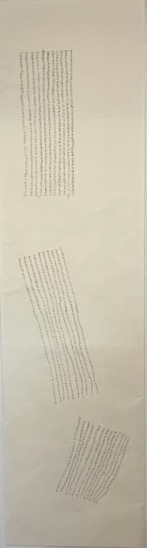
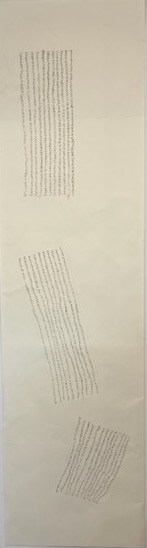
Here's what I'm thinking about for my work about "persistence"--a large piece of cloth (about 90" in longest dimension), on which I stitch thousands of marks in linear configurations.  I've made a full-size sketch that roughly replicates the layout of the three major alignments in Carnac. This is just a very early starting point and the final piece may bear little resemblance to this, but it's enough to serve as a kind of placeholder. Right now, it is hanging vertically on my design wall, but it may end up horizontal.


This rough sketch in place, I went on to do stitching trials, trying out the kinds of marks I might make, with what kind of thread, and in what colors.  I started out with the heavy natural linen I enjoy working with (4C22 from Fabrics-Store), and a black silk-wrapped linen thread that I had on hand from Habu Textiles


Then more sampling with different threads, this time stitching on linen that has been colored with different hues/values of earth pigments (more on earth pigments below):


This helped me decide that I prefer a light or medium-light color for the stitches, on a dark background. 

In order to try out a range of colors/values for the thread, I purchased a few different flat threads from Habu, which I can dye myself. (I like how a flat thread yields unexpected shapes in the stitches.)


Here's one of the threads, dyed with 2 different light grays, though it is difficult to tell the difference in hue at this light value.


And here are trials with three different threads from Habu, all dyed very light gray:


Now to explain the earth pigmented fabric. From an early stage, I've been talking with my friend Sheryl St. Germain about this project. Sheryl and I both attended a 2022 workshop by Susan Brandeis that centered on hand-stitching. I focused on stitching that I might use for my work about menhirs, and Sheryl was working with cloth that she had painted with earth pigments, a method of coloring cloth that she had recently learned from Claire Benn. We continued to e-mail back and forth about our work after the workshop. When I wrote about my decision to not use the natural linen, along with some thoughts about dyeing the background fabric, Sheryl suggested using earth pigments instead of chemical dyes. I liked the idea of this--because of the close association of earth and stone in these neolithic monuments--but I knew from hearing about Sheryl's experience that the process of using earth pigments was very different from anything I had done before, and I just didn't have it in me to learn a whole new process that I might not use again after this one project. Sheryl then offered to color the cloth for me. This was such a deeply generous offer that I hesitated to accept, but her offer came from the heart, and I opened my heart to accept. (It happens that this was one thing that has led me to think about how hard it can be to accept help, and I'm learning that accepting help is as important to a life well lived as is giving help.) 

Here are the samples that Sheryl worked up for me early in the design process, before I had decided whether I wanted the background to be light or dark. Sheryl tested three different earth pigments (all in the grayish/brown range that I wanted), in 2 or 3 different values.


I've picked the color in the lower right corner. My cloth will have the earth pigment applied late in August, and then it will need another four weeks to cure before I can work with it. This gives me the additional time I need to do some further thread trials, both of dyeing and stitching.

This is the first time that one of my personal works has become a collaborative project, and that scared me at first--how could I give over a central, physical part of the project to someone else? All of my work has been shaped significantly by extended discussion with friends and teachers, but I've always done all the actual work myself. But giving up control can be a good thing, and having Sheryl move forward with the cloth experiments has helped keep me moving forward on my part of the project. And of course our discussions all along the way have helped me find my way to the composition this will become.

THANK YOU SHERYL!!


July 24, 2023

Menhirs

In 2019, my husband and I went to France, and we spent several days in Brittany, including two days in Carnac. The neolithic stone monuments there made a deep impression on me--thousands of menhirs (large stones placed upright) arranged in rows over a space of over two miles.  The monuments date from about 4500-3300 BCE, so about 6,000 years ago (1,000 or more years earlier than Stonehenge). 

Here are a couple of aerial views of portions of the stone alignments: from way above and closer in. And here's a video that puts together aerial views of many alignments in Brittany. (Ignore the creepy music at the start; it soon quiets down. There's no narration.)

Of course standing amongst the stones, one doesn't get such an overview. Instead, there is a feeling of immersion in a massive enterprise.


The stones range in size from about 2 to 13 feet. You can see the scale of some of the larger stones in the next photo, which includes a human visitor in the center foreground.


The stones are many different shapes, and were taken from outcrops of stones right in the area. The stones are mostly unworked, but some have been lightly shaped.


You can see the overall plan of the 3 major alignments here, and some additional photos here. [Added 8-25-25: And here's a video with great aerial views of the alignments in Brittany.]

My initial response was a sense of awe at the enormity of the human project, which must have required persistence over many years. There had to be a collective commitment to an endeavor that would eventually result in the lines of stones and the corridors in between them. This was my starting place: that the stones were a kind of witness to the persistence of humans, creating together a monument of deep meaning to them.  So, the first words I had in mind as I thought about a possible art work in response to the alignments were "persistence" and "witness," and I have one piece sketched out that is centered on this theme. (More about that in a subsequent post.)

But I was also driven to find out what I could about the possible meaning of these lines of stones to the neolithic people who placed them. From the museum in Carnac and from early reading, it quickly became clear that there will never be a consensus on the issue of meaning. Archaeoastronomical explanations (e.g. connection to a solstice) don't work for these configurations, and of course there is no written record to refer to. I've been driven to do a fair amount of reading in the scholarship on these and other neolithic sites--a practice of reading and note-taking that I thought I'd left behind when I stopped doing historical scholarship in 2004. But here I am again, trying to piece together what some human actions meant, based on whatever evidence one could find--in this case physical evidence rather than written.

I am still reading and thinking about this, but it now makes sense to me that the overarching meaning of the alignments, taken together with other kinds of contemporary monuments in the same area--dolmens (stone tombs) and tumuli (burial mounds)--is connected to death and remembrance. That the manipulation of stone and earth (the stones "planted" in the earth, and earth mounded over stones) is an elemental response to human loss. (There are no burials associated with the menhirs, but the location of the lines of menhirs in relationship to the dolmens and tumuli puts the overall complex in close relationship to death and its associated emotions and practices.)

So. . . this brings me back to familiar territory, as a significant part of my previous work on loss was centered on stone, described here. I am in the midst of sketching out a second piece on the alignments that centers on this theme. I'll also write more about this in a later post.


July 23, 2023

I'm back!

I've been unable to post to this blog starting last fall, so back in January, I put the last two posts about my recently completed Ellsworth Kelly quilt on my recipe blog. With the help of a team of friends, the problem has finally been solved, and earlier this month, I re-posted those two entries here on StudioNotes. Many thanks to Wanda Hanson (blogger extraordinaire), Rick Ortner, and David Amor for the string of suggestions that led to the solution! It turned out to be a too-vigorous blocker by the new internet provider we started with last fall.

In the meantime, I've been working on a large new project that I am ready to start writing about. Not having the blog has slowed down progress. This has made me realize how much occasional writing to a public forum helps advance my thinking/working. It gives me a reason to think through issues that come up in the work, and it nudges me to keep making progress, because other people know I'm working on something.

I am in the midst of writing a post about my current project and will post that soon. As always, I look forward to any comments you may have!

July 6, 2023

"Homage to Ellsworth Kelly II" on its bed, with cats (originally posted January 9, 2023)

And here's a photo of the quilt in its final home--I'm really pleased with how it looks, cats included!

Final Post on "Homage to Ellsworth Kelly II" (originally posted January 1, 2023)


I started this quilt in the spring of 2021 and finished it in the fall of 2022. The quilt presented some challenges along the way, especially in working with the heavy, loosely woven linen and in quilting, but I am very pleased with the final result, and so, happily, are the recipients! The quilt is 90 x 94", made for a queen-size bed. The central medallion covers the top of the mattress, and the three plain borders drop over the side and bottom edges.

When I last wrote about the quilt, in June, I had decided to set aside the free-motion quilting I'd been planning on (which would have been in the tan only, not in the black) and to try straight-line quilting instead. [Here's a link to that old post; you can read the content in this "back end" version, but links to other posts will not work.] I usually prefer straight-line quilting, but for this quilt, I was worried about having thread visible in the black cloth--any thread light enough to blend with the tan linen would show up too much on the black. But then I remembered a kind of thread I hadn't used in a while, Invisafil, which is a very thin (100 wt) polyester thread that is colored, and yet blends in with a range of colors/values of fabric, much more so that the 50 wt cotton thread I normally use. I had stopped using Invisafil because it kept breaking in the new machine I bought several years ago, but I thought it was worth another try. To my delight, I had no trouble with breakage, and the charcoal gray color that I had on hand blended well with both the tan and the black, despite the large contrast of value between them:


Once washed, the thread sinks into the fabric, and just looks like a shadow made by the quilted line.


I'm definitely glad I went with the straight-line quilting, rather than free motion--here's the earlier trial piece with free-motion:


I wrote previously about the work it took to dye fabric for the back. I'm happy with the color I ended up with, and plan to keep some on hand for use in other projects. I also used it for the end panels on a couple of pillowcases I made for possible use with the quilt (body is from fabric by Marcia Derse).


So, a fond farewell to this quilt!