Showing posts with label regret. Show all posts

July 25, 2014

Regret


REGRET

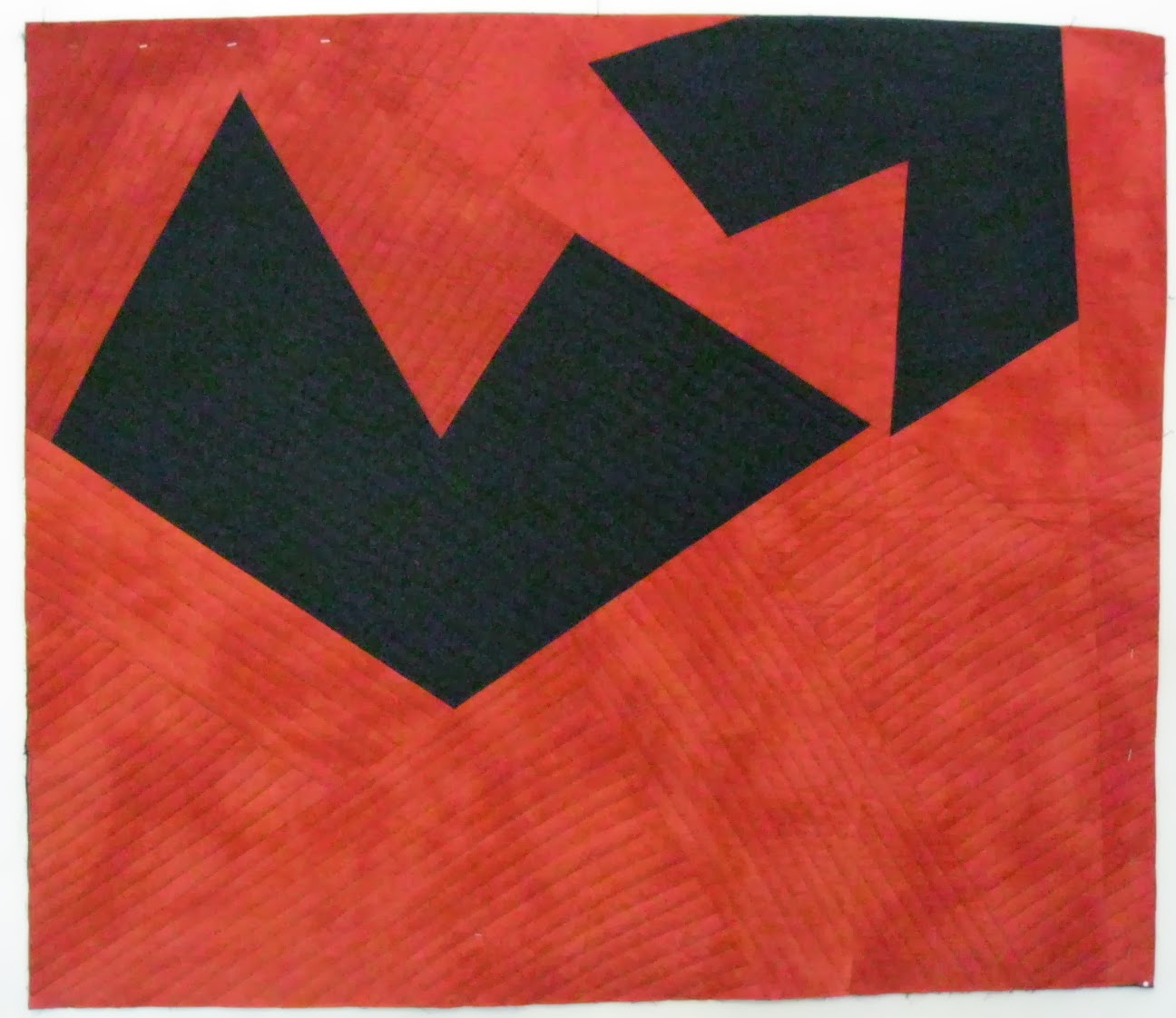
This quilt (72 x 60") is now finished .  You can retrieve the history of its making from this post.  I am satisfied that the basic graphic design of the quilt captures what I had in mind--the nature of the feeling of regret, which, for me, has to do with a missed connection between two people.

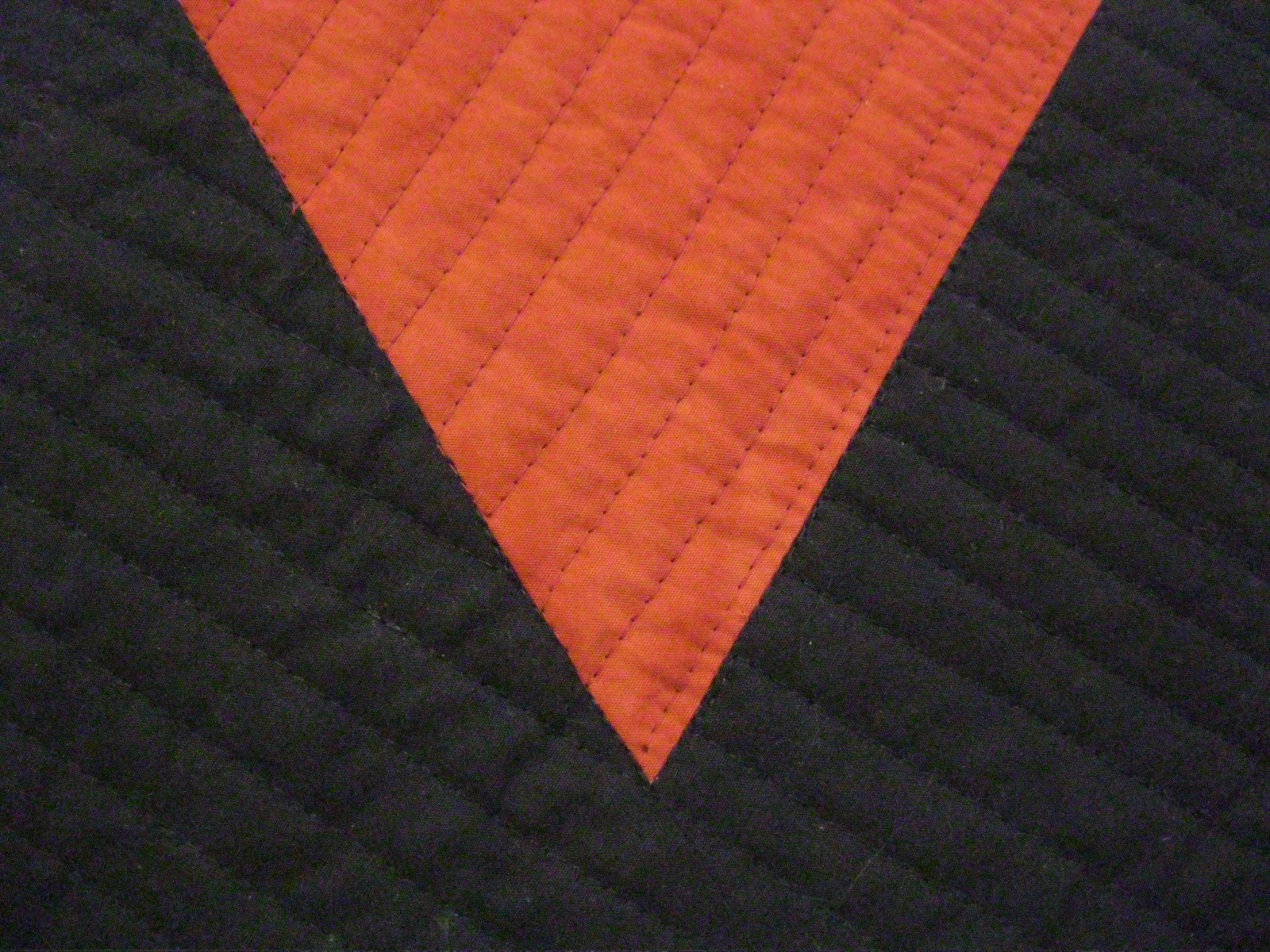
A detail of the quilting from the front (double-click to enlarge; color more accurate above); both thread and fabric were hand-dyed.


And a detail from the back. By comparing the two detail photos, you can see how the short parallel stitches on one side turn into a dash-dot pattern on the other side:


I am not entirely satisfied with how the quilting turned out.  Looking up close is fine, and from a far distance is fine.  But standing a normal viewing distance away, I'm bothered by the puckering that happened, especially in the bottom half of the quilt, a result of the the batting material (flannel) and binding method (pillowcase binding, sewn before the quilting) that I used.  After ironing, the puckering was reduced enough that I'm content to show these photos and to put the quilt in my local guild show next month.  But one of these days, I may come back to this, and do a machine quilted version as well. Before I decided on hand-quilting, I machine stitched a small maquette of the quilt.  Here's a detail of it:


And a view of the whole--I added some complexity to the background by having the lines go in various directions:


Or I could instead do straight (diagonal) lines across the whole quilt.  Or lines going in one direction in the background and another direction on the black figures.

But in the meantime, I've got a few more major quilts in mind, and they get higher priority.


November 12, 2013

Quilting Regret


I finished piecing the top of "Regret" back in March, described here, where you can see the whole composition.  It took me a long time to figure out what to do about the quilting.  My working plan was to do straight-line machine stitching, which I felt to be in keeping with the starkness of the image/message.  Here's a small maquette I did, quilted in this fashion. (Figures in the final version are placed slightly differently.)
But I couldn't figure out what to do in the black figures, which I thought should be quilted differently from the background.  I was also considering parallel lines going in just one direction through the whole quilt, maybe diagonally.  I had considered hand-quilting, but didn't want the "softness" of look/feel one gets with hand-stitching.  And part of me felt, "I've been working on this quilt long enough.  I want to get it over with, and machine stitching will be so much quicker."

Then I took Dorothy Caldwell's workshop on "Human Marks" last spring.  One of the exercises in the class led me to a stitch (improvised, done while blind-folded, to the word "dialogue") that I've come to think of as my "conversation" stitch.  I tried it out in a small sampler piece (stitched on an entirely different project), detail below.


I decided that this stitch would be meaningful to use in this quilt about regret, which, after all, often comes from missed conversations, or conversations gone awry.  I began the stitch in the black areas.  I liked the way the stitch looked on the back side of the quilt as well, so in the red areas, I've done the same stitch, but worked from the back.  Here's the corner of the quilt that I've quilted so far.  (Ignore the long blue stitches--that's just basting to hold the layers together).

A close-up of the stitching is the top photo in this post.  I've used an occasional black thread in the red area.  I may or may not keep it in--I'll see what I think when more is stitched.  Very easy to remove if I don't like it (one of the benefits of hand-stitching--machine stitching is much more difficult to remove).  I may also try a little red stitching in the black.  The thread, by the way, was dyed to match my hand-dyed fabrics, just lightening the black into charcoal, so that it would show up on the black.

I wanted to keep the quilt as flat as possible (easier with machine stitching than hand-quilting).  I tried stitching just through two layers of fabric, no batting at all (which is how many of Dorothy Caldwell's pieces are done), but I found I missed the sense of weight as I held the fabric on my lap.  I tried a couple of thin battings, but one was not thin enough, and the other "bearded" (bits of batting work their way through the fabric).  I ended up using just a layer of black flannel in the middle--thin, easy to work with the needle, but still gives me the weight I like to feel as I hand-quilt.

Below is the back of the quilt, before quilting.  One of my other quilting ideas had been to write out in machine-stitching the regrets that have fueled the making of this quilt, and I made a list of them to prepare for that.  But when I did trials of the quilting, I found it not satisfying--one can't be as fluid in machine stitching words (especially over such a large surface as this quilt, about 60" wide) as one can in writing by hand.  I decided instead to incorporate the words by writing them on the back of the quilt, and I'm happy with that choice.  Rather than writing in straight lines across the whole quilt, the sentences are written out in sections.  To obscure the writing, I overlapped the lines a little bit.  Words are still sometimes legible, but it is difficult to read more than a word or two in a row, even for me.


Many thanks to my fellow students at Dorothy Caldwell's workshop, whose diverse and beautiful work have so inspired me--and who also coached me through the process of dyeing thread, which I hadn't tried before.  And thanks to Dorothy for her total love of mark-making, and for the encouragement to slow down, and to look at the back of things.

. . . . .

It might be that machine stitching in parallel lines would have been a better choice for the final appearance of this quilt, and it's not impossible I'll do another version that way some time.  But sitting with the quilt for the months it will take to finish this, maybe letting some of my regrets dissipate a bit along the way. . . it's been the right thing for me to do.


March 13, 2013

"Regret"--the top is pieced


It's been a long time since I posted about this quilt, but I have slowly been making progress.  There were lots of decisions to be made before I cut into the fabric.  You can see the story of this quilt on "Regret" here.  That post shows a small maquette of the quilt; the maquette was about 28x23", while the actual quilt top is 72x60".  The basic design remained the same, but I tipped the figure on the left a bit, which I think is an improvement.  The design process was arduous; the simpler the design, and the smaller the range of colors, the more impact each decision has.  I won't go into the many days it took me to dye exactly the red I wanted, and then to replicate it on the 3 pieces of fabric I needed to cut all the shapes.  The black too, took some trials, as there are two different blacks that I commonly use.  With the fabric finally done this weekend, I could go back to the full-size pattern I'd made and start cutting.  I'm glad I did a lot of garment sewing in my teens and twenties, as it made sense to construct this quilt using many of those techniques, which I thankfully remembered.  Things like using a pattern, cutting notches to help match up seams, using a 5/8" seam (versus the 1/4" generally used in quilting), pressing open the seams, stay-stitching around the outer edge, much of which is on the bias.  Here's a photo of the pattern, which I cut into its component parts and laid out on the fabric:

A detail shot shows a little better how I marked the cutting lines.  The pencilled scribble is a trial of the quilting.  More about that once I get to the quilting stage.

As I mentioned in an earlier post, I had originally planned to do this design through applique, starting with one large piece of rusty/red fabric and hand-sewing the black shapes on top.  I did the maquette to try out piecing instead, and I decided I preferred the very straight lines and sharper corners that I could get with piecing.  I'd prefer not to have the piecing lines visible in the background, but they're not dominant, and I think once the piece is quilted, they will mostly disappear.

This quilt has been a long time in the making.  I am glad to have reached the point where it has actually come into being.  There is a lot more to do, but it should be easier from here.

There was a bit of magic, too, in the making.  I struggled with dyeing the fabric, and I struggled some when cutting out the pieces, making a couple of mistakes that necessitated re-cutting, and having to break down a couple of larger pieces into smaller parts.  This is par for the course for me.  Even when I think I'm being careful, I make mistakes.  I just accept it as part of the process for me.  But when I was piecing, everything went together on the first pass.  My trusty seam-ripper, always at hand, was not picked up once.  Because of the irregular shapes of the pieces, many of the edges were on the bias of the fabric, rather than straight of grain, which I thought would be problematic in the sewing.  But for this, I seem to have been careful enough, and it's all OK!

The pattern pieces, having done their job.


September 26, 2012

Regret--further thoughts


Since my last post on "Regret," I've gone back to my blog several times for one reason or another.  Each time I've looked at the top photo on my August 31 post, I've thought, "not there yet."  I'm thinking the idea behind the quilt might be better expressed by focusing close up on the point of highest tension in the piece--the narrow space between the two figures, as in the photo above.  (Ignore the quilting trials currently in the piece--I'm thinking now just of the interaction of the shapes.)  Very early in the process of sketching this quilt, my friend Mary Beth made a frame around this section, suggesting a focus here.  As I worked on the larger piece, I forgot about this, and then remembered it again more recently.  I thought I would make it as a second quilt.  But maybe this is what I should move to now--this smaller section, sized up to a large quilt.  The next step will be to cut out some large truncated shapes and play around with them on a background. 

August 31, 2012

Regret


For several years I've been making notes and sketches for a quilt about "regret."  In the last year or so I finalized the design, seen above in a small maquette; the final quilt will be about 60x72."  My interest has been to capture the nature of the feeling of regret, which to me has to do with a missed connection between two people.  My experience of regret has been intensified by the death of people I love--my parents in 2003 and my son in 2004.  Once a person is gone, those missed/failed connections become more salient, and, at the same time, there is no longer a possibility of repair.  No further chance to apologize, or to change a behavior.  Working on this quilt has helped me understand the pull that regret has come to have in my life.  Working on the quilt hasn't eased the pain, but it has helped me live with it.

There are still key decisions to be made on the construction of the quilt.
  • Should the black figures be appliqued onto one large background piece, or should it all be pieced?  For a long time I assumed I would use applique, but I did this maquette through piecing, in order to get reliably sharp points on the figures (e.g. in photo below).  Other design features will follow from the method I end up choosing.
  • Should the rusty/red background fabric be somewhat mottled or closer to solid?  (This is all fabric I'm dyeing myself, so I can control for this.)
  • What quilting will best express the meaning of the piece, including the differentiation of the figures from the ground?  In this maquette I used mostly straight-line quilting, with one-direction in the figure and multiple directions in the background.  Maybe reverse that?  I've also tried out some hand-quilting in the second figure. (Shown below--you'll probably need to double-click on the image to see this.  I originally machine-quilted the whole piece, but picked out the stitching in the upper right corner so I could try some other things.)
I have received some very helpful (and conflicting) advice from people whose critique I appreciate and trust, and I will be doing some more experimentation along the lines they've suggested.  But probably most important, I now need to make some quiet space to think about which decisions will most successfully express the ideas I have about regret.

November 10, 2010

Regret


Here are the first sketches for what I think will be my next "idea-centered" quilt, this one about "regret." These sketches are each about 7"x9", black fabric cut with scissors and trials of different fabrics underneath. (I don't know why the photos on the main page are fuzzy, but if you double-click on the image, you'll get a much better one.) The shapes on the first three pieces were made through spontaneously cutting; in the fourth (on the right), I drew the shape on the black fabric and then cut it out. I think that worked better. I also like the wider shape. I'm directly influenced here by the artist Clyfford Still, whose work I came across a couple of months ago. I was really happy to see a couple of paintings of his this past weekend at the exhibition of Abstract Expressionist art currently at the Museum of Modern Art in New York; here's an image of one very close to one of my favorites. (I strongly recommend the exhibition, which is up through April 25, 2011. Here's a link to a number of the images in the show.)


Next steps? I think I'll pursue the shape in the fourth sketch, trying out other single shapes as well as combinations of shapes within one composition; same for trials of the underneath color. I'm not yet sure if this will be about "regret"--the naming of a particular type of feeling--or about "regrets"--a pervasive, underlying sense of foundations undermined. Perhaps there will need to be more than one work on this theme. And eventual size? I'm envisioning it fairly large, maybe 40 x 55.