Showing posts with label tutorial. Show all posts

April 14, 2018

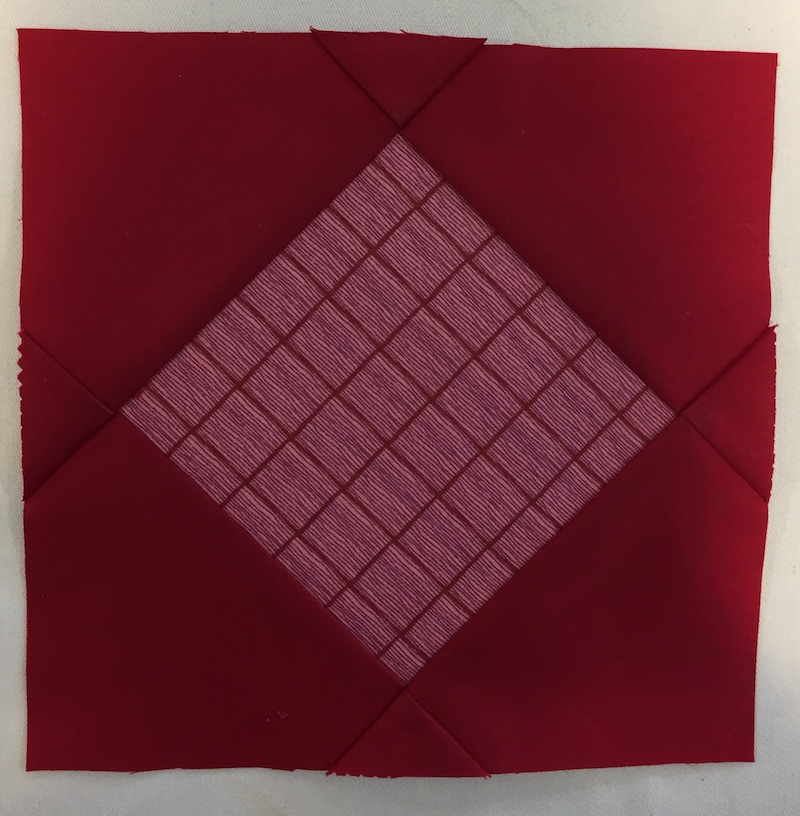
Square-in-a-square tutorial: done by folding, no cutting of pieces!


Square-in-square tutorial: made with folds, no cutting

Many thanks to Judy Chaffee, who taught this method to a group of us at a recent quilting retreat. She learned it at a Modern Quilt Guild meeting in Kansas City, where the group used it to make some charity quilts. Both Judy and I looked for a pre-existing tutorial using google searches, but couldn't find one, so I've written up how to make the block. This method produces very quickly.

These directions use two squares of fabric, 5" and 10". These are convenient if you like pre-cuts (charm packs and layer cakes), but the method works for any size, smaller or larger. The small square does not have to be half the size of the larger square—vary according to the look you are after. Making the basic version, the unfinished block will be 1" smaller than the largest square, 1-1/2" when finished.

Basic version (with photos illlustrating steps below):
1.    Put a 5" square right-side up on a 10" square, also right-side up.
2.    Line up a straight-edge (cardstock, folded piece of paper, ruler) with the top of the 5" square and fold the background fabric over the edge. Iron in place. Remove the straight-edge. (If using a ruler as the straightedge, remove the ruler before ironing, being careful to keep fold in place.)
3.    Repeat the folding/pressing on the bottom of the 5" square.
4.    Sew a 1/4" seam, sewing the two folds down (top and bottom).
5.    Iron seams open.
6.    Repeat fold-press-sew on other two sides.
7.    Done!
Step 1: Place small square on large square, both right side up.

Step 2: Place "straight-edge" over small square, lined up with its top edge.  Fold over background fabric and press. The dark 5" square is not visible, underneath the pink paper.
Step 2, another view: Folded flap lifted up, so you can see the crease.

Step 3: Both top and bottom folded down; you can see the 5" square peeking from underneath.

Step 4: Sew 1/4" seams. 

Step 5: Iron seams open.
[Ignore the fact that the central fabric is different from what's shown in the first photo. I forgot to take a photo of step 1, so had to substitute something later for the first photo.]

Step 6: Fold and press repeated on the other two sides.

Step 6: Sew seams on final 2 sides.

Step 7: Finished square-in-square.

View of the back; note that the block has two layers of fabric in the central square, so there is some added thickness.
Alternate versions (see photos below): When doing alternate versions, just be careful to maintain enough of the background fabric for an ample seam allowance (i.e., leave at least 1/2" of background showing)
    Vary the size of the squares and/or vary the proportion of small to large square.
    Place the square somewhere else than in the center--e.g., towards one corner.
    Do the process more than once for multiple frames.
    Place the square on point, or wonky. You'll end up with a square that needs some trimming down.

Smaller central square

Place the small square in a place other than the center.  And do the process twice for a double-framed square. This Thomas Jefferson block was made by Dorothy Roderick. 

On point.

September 4, 2013

Great use for multi-color hand-dyed fabric--and a tutorial for 2-layer receiving blankets


I found a great way to use the multi-colored hand-dyed pieces that I did a week ago--I can use them for one side of a two-layer receiving blanket (other side is flannel).  I've made these before, but using commercial fabric for both sides.  See this post for a description of the blanket and why it makes a great baby gift.  It's also less time-consuming than making an actual quilt, and using the hand-dyed fabric will still give it a personal touch.

Here are two more; all three of these were made with flannel that I had purchased to go with some commercial fabric I had on hand, but that's now back in my stash.


The next one has some applique patches added, because the fabric (an inexpensive muslin) had some holes in it after the washout.


 Here are instructions for the blanket--very simple!

TWO-LAYER RECEIVING BLANKET


Material: 
1-1/4 yd flannel
1-1/4 yd cotton (not flannel) 

1.       Prewash and dry the fabrics.
2.       The flannel:  Cut off the selvages, and then trim the other edges.  You'll end up with something about about 42" square. Anything around this size is fine; no need for the width to be exactly the same as the length.
3.       The cotton:  Cut off the selvages, but leave the rest untrimmed.  (This piece of fabric should be a little larger than the flannel.)  Pin the cotton to a design wall, wrong side of fabric towards the wall.  Smooth it out well, pinning it to the wall at about 6" intervals.
4.       Placing the layers together:  Put the flannel up against the cotton, right sides together.  Stick pins into the two layers all around.  (You can move pins from sticking up the cotton to pierce both layers—but leave 2 or 3 pins across the top edge of the cotton fabric as well.)  Do not try to match the edges of the two fabrics.  Just be sure there is a bit of the cotton fabric sticking out beyond the flannel, all the way around.  (If need be, you can cut down the flannel a bit.)  Then go around pin the two fabrics together, preparing them to be sewn on the machine.  When all is pinned, take the two layers off the wall and bring to the machine.
5.       Sewing the layers:  Sew around the edge of the two layers with a half-inch seam, measuring from the cut edge of the flannel, and leaving an opening large enough for your hand to go through.*
6.       Trim: Put the sewn blanket on the cutting table, flannel side up.  Take your rotary cutter and trim the cotton so that it's even with the flannel—no need for a ruler, you can just do this by eye.  Then trim the corners a bit so there's less bulk when turning.
7.       Turn: Turn the blanket, pushing out the corners carefully—no need to get a sharp point!  Iron the seams flat.  No need to sew the opening closed by hand—it will get closed in the next step.
8.       Topstitch: Topstitch around the edge of the blanket, starting a few inches before the opening.  I top-stitch 5/16" from the edge (this is the measurement of my all-purpose foot).**

*I have rounded the corners on one or two of the blankets I've made, including the one at the top of this post (marking a curved line with a small plate), but I like better the ones I've made with a regular 90-degree corner.

**I have used a decorative stitch for the topstitching a couple of times (photo below), but I prefer the look and feel of a plain straight-stitch, and it's faster too.