January 16, 2011

Travel appliqué put together--and borders?


I decided to do the "on point" diagonal setting for these blocks, but to take a row off at the bottom so that I didn't have to make more blocks.  The top as is comes to 64" square; I'll add a couple of borders, which will make it a good size for a throw on our couch.  The gray used for the setting triangles and corners is a little lighter than that used for the squares--an accident of different dye lots for this Kona cotton, but I actually like the slight contrast.  This arrangement leaves me with a couple of "orphan blocks," but I have good uses for them.  One of them was not a favorite; I can use it to do some trial quilting.  The other was a much more intricate design than the rest, and in a different style.  I think I'll put some borders on it (below) and make it into a wall hanging; the single block is 15" square:


Then I auditioned a couple of different border possibilities:  a sawtooth border and a plain strip (one above the other in photo on left below).   Better to combine them--first a plain strip and then sawtooth outside that one (center).  I also tried out a dogtooth design (the "mountains" on right), but like the sawtooth better. 

Next is one of my least favorite parts of quilting--doing the math in order to figure out how to get the sawtooth triangles to fit neatly around.  This is what usually keeps me from doing anything except the simplest borders!  But since I'll be inserting a plain border before the sawtooth one, I should be able to size that border in such a way that the math for the sawtooth pieces comes out.  This is a task that must wait until I'm feeling sharp.  Now, if my mother (former math teacher) were alive, I could give her the measurements and she would enjoy working it out! 

January 11, 2011

Travel appliqué

I like to carry appliqué with me when I travel, and a long trip last month--almost four weeks away from home--gave me a chance to finish up a few more blocks in this very long-term project; I only work on it when I'm travelling.  These blocks will be trimmed to 15"; I have one more basted up that I'm still working on.  If I do a diagonal set like this, I'll need to make six more blocks; the side triangles will probably be plain grey.  If I do a straight set as below (to which I would probably add sashing), I just need the one more that's in progress.  Cutwork applique like this works really well for travelling, as I can baste the whole block together before I leave home and not worry about losing little pieces.  I didn't do a lot of planning in the blocks--just picked designs I liked.  Not sure this ends up being the best design overall, but I got a lot of pleasure in the making of it.


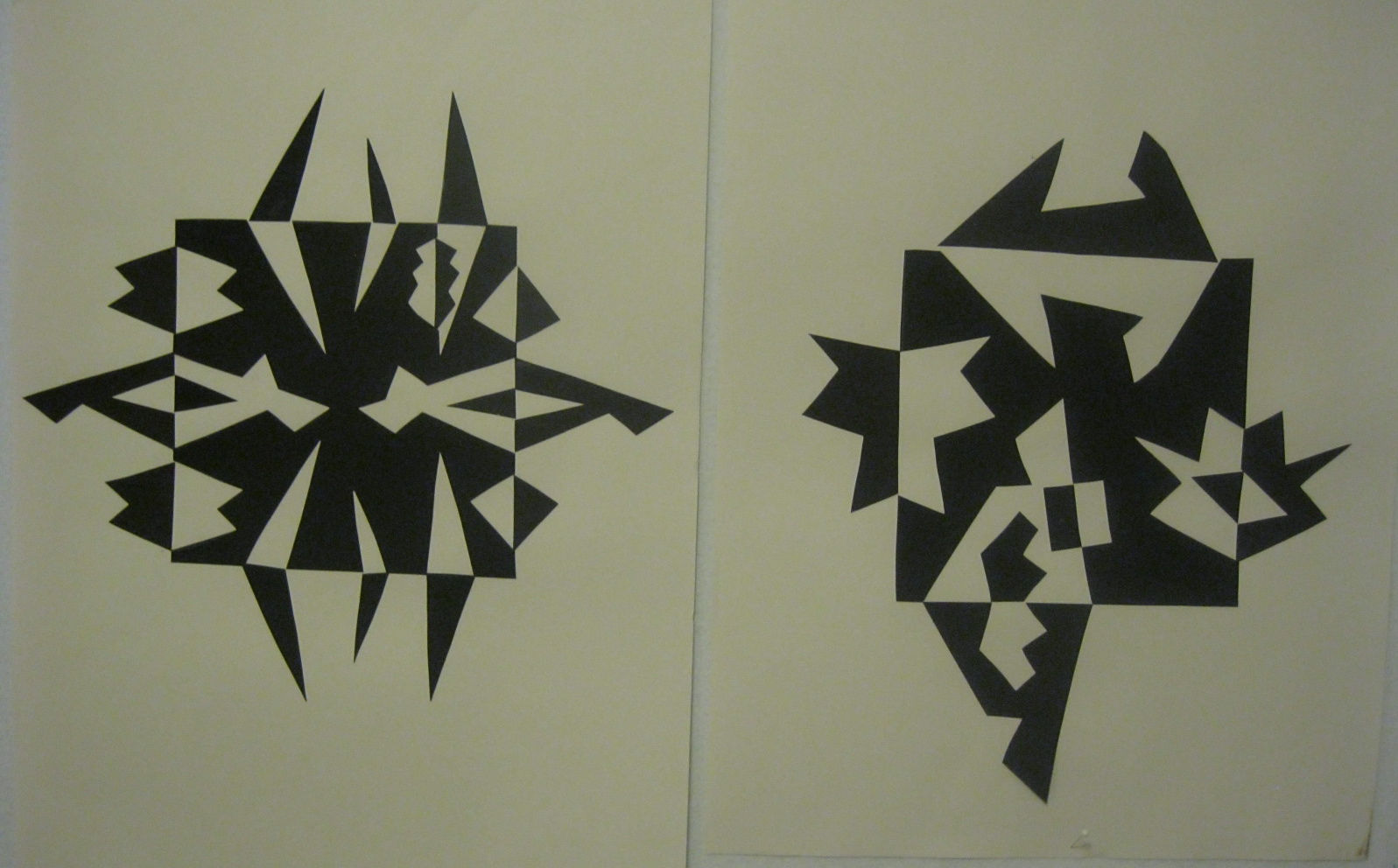
Being without a sewing machine for a month, and knowing I had to limit how much hand-sewing I did (because of the pain I've had in my hand), I decided this would be a good time to work through the Notan design exercises in the book below, something I've been wanting to do for a while.  One of the weeks away was in a rented house in Hawaii (the Big Island), a beautiful, quiet place up a mountain, in rainforest landscape. It was lovely to sit out on the lanai and cut and paste paper. 


Here are a couple of tries at the "expansion of the square" exercise.


Here's the house we rented, for a very reasonable price.
 This is the back yard.  I spent some very pleasant time sitting out here with my applique or a book.
I would highly recommend this particular rental, which you can find here: http://www.vrbo.com/61570

November 29, 2010

Midwestern Landscape: in pastel and cloth

In the summer of 2008, I did a week-long mixed media workshop at the Arrowmont School of Arts and Crafts.  One of the results of that workshop was this pastel work--layers and layers of pastel on 9x12" rectangles of paper.  I was working with an idea I had long had for a quilt about the midwestern landscape in late March.  I like this work quite a lot; it hangs on the wall in our living room.  

One of the important results of the Arrowmont workshop (where I also did some work with water color) was that it gave me confidence that I could mix colors in order to get the vision of color I wanted, which led me to learn how to paint fabric and to take a workshop on fabric dyeing.  This past summer, I finally got around to dyeing fabric for a quilt version of the landscape.  I haven't yet quilted it--still thinking about what to do--but here's the top (each block is again 9x12", total dimensions 45x60"):

And here's a table runner that I made this weekend, with smaller blocks, 3x4, for total dimensions of 12x44" 

For the back and binding, I used some sage-colored Kona fabric that I overdyed with greens and brown.

I quilted with random, narrowly spaced wavy lines, which I like.  Perhaps this would work for the larger version as well.

Looking at a detail of the front, you can see one problem with the quilting--the right/left edges of the blocks have gotten distorted out of line by the quilting.  Some people recommend quilting the lines all in the same direction to avoid this.  Others recommend alternating directions.  I tried both ways in a sample, and got distortion with both methods :-(   One other thing to try is even more meticulous pin-basting than I already do, perhaps taking care to pin right in the seams.  If anyone has suggestions for me, I'd love to hear them!


November 26, 2010

Another blog for recipes

Following the example of Kathy Loomis, whose quilts I admire, I've started a second blog about cooking, focusing on favorite recipes.

November 15, 2010

More on abstract expressionist art

Lee Krasner, Untitled, 1949. . . and me (photograph by Kay Mathew)
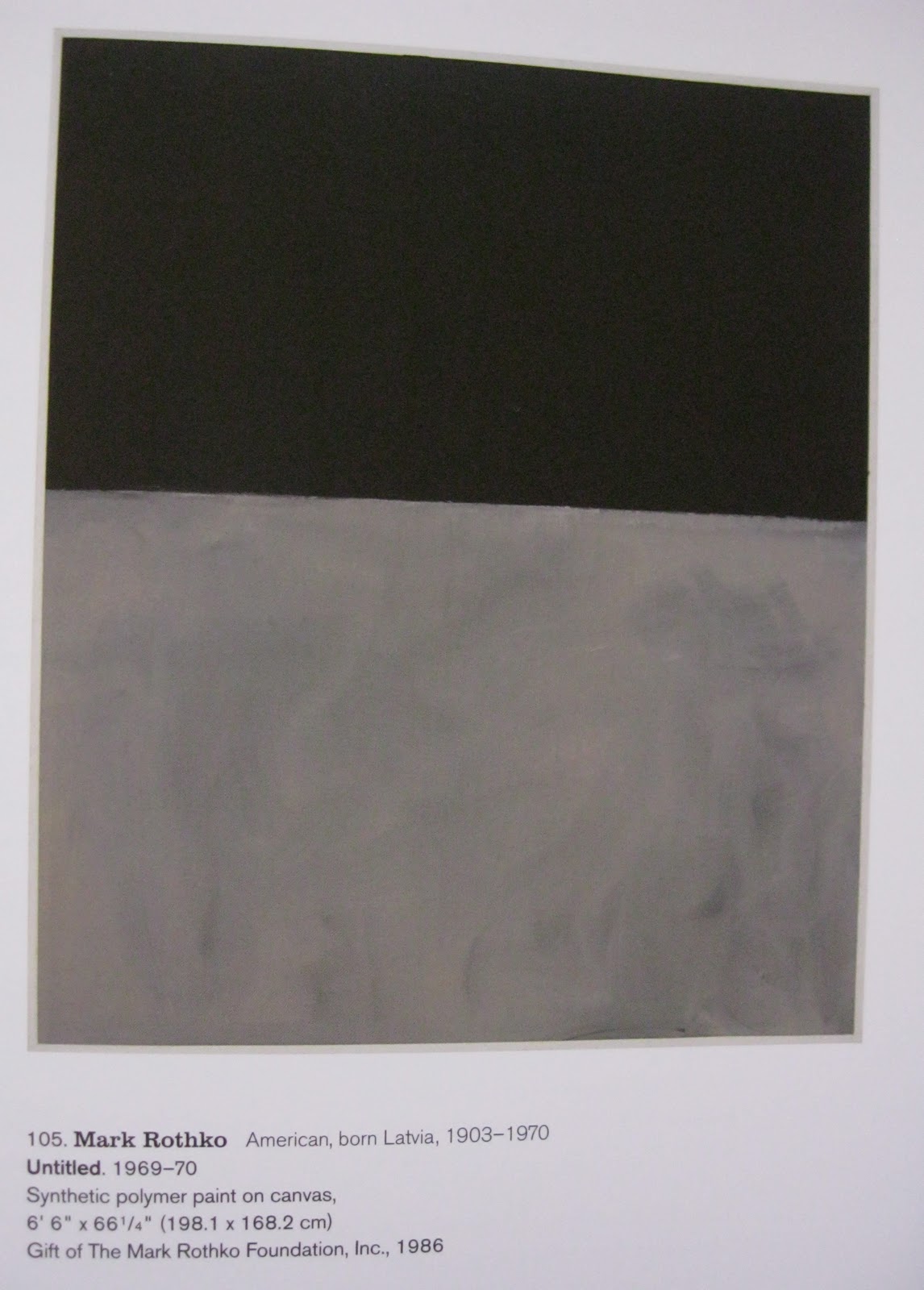
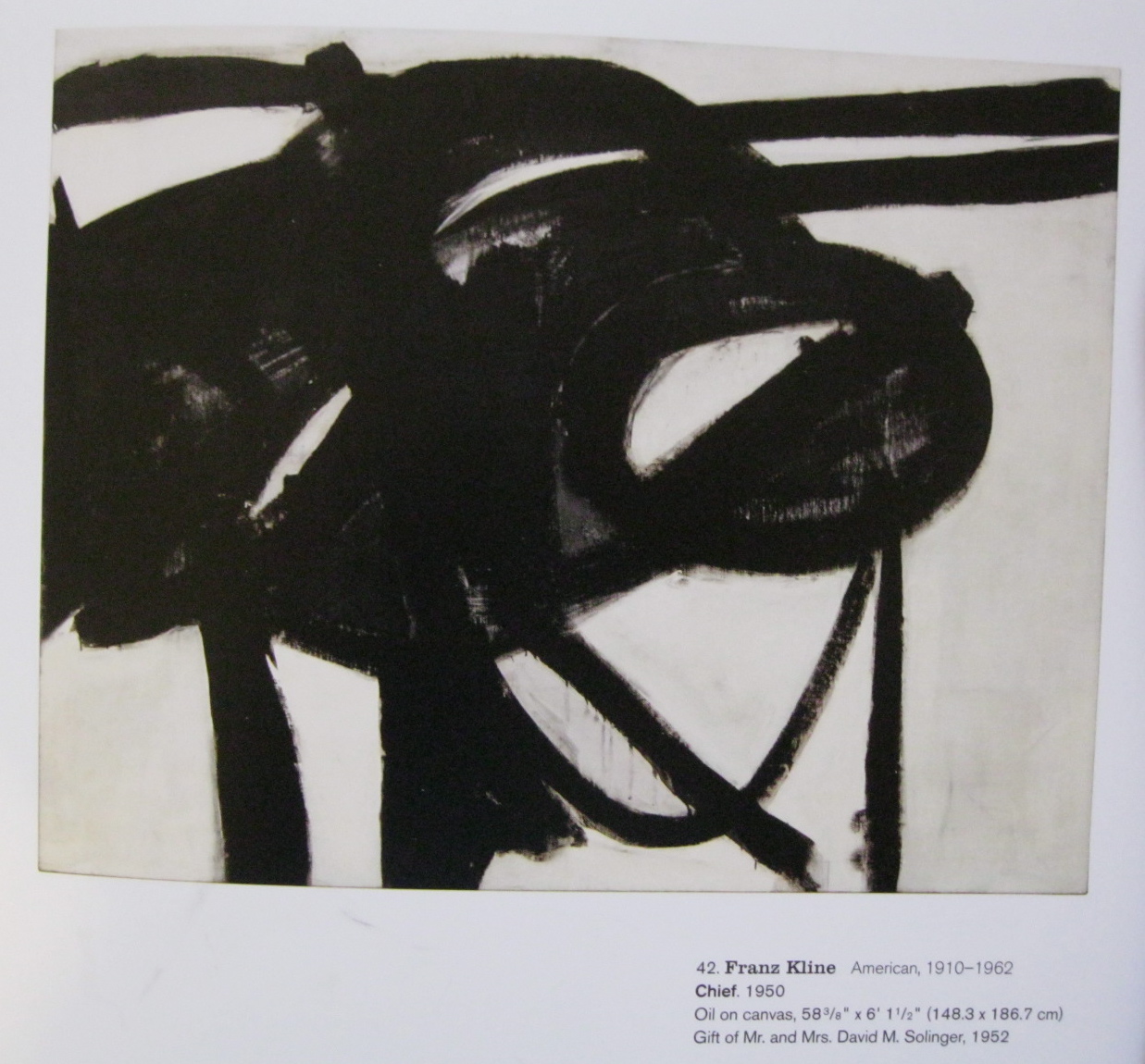
I mentioned a few days ago that I recently went to the exhibit of abstract expressionist art at MOMA.  There was so much in this exhibit that I responded to.  Some by artists I already knew and loved (Mark Rothko, Clyfford Still, Joan Mitchell, Franz Kline, Louise Nevelson, Hans Hoffman), some by artists I knew of, but had not seen work that moved me as some of the work in this show did (Barnett Newman, especially his etchings, Robert Motherwell, Lee Krasner), and then some artists I didn't know of at all (Adolph Gottlieb, Grace Hartigan, Bradley Walker Tomlin) and photographers too (Aaron Siskind, Harry Callahan).  The narrative/analysis that accompanied the art works was also unusually helpful and illuminating.  Two interrelated characteristics of much of this work were clarified for me:  the use of a grid, and the use of invented forms as a kind of language.  "The artists used the structure of the grid to compose paintings that provide compartments for the individual signs.  Gottlieb wrote, 'One can say that my paintings are like a house, in which each occupant has a room of his own.'"  Food for thought for a quilter. . .  The Gottlieb painting that this quote was next to was my favorite of his in the show, but the only image I can find is this black and white photo documenting a show in 1969 (from the exhibition catalog, Ann Temkin, Abstract Expressionism at the Museum of Modern Art, 2010); the Gottlieb is the painting on the right in the foreground. (I'm not sure if it's OK to put these images from the catalog on the blog.  I've noticed that in many quilting blogs, people put up images from books they like--people who seem to be careful about copyright when it comes to the quilts themselves.  If someone lets me know that I shouldn't have these photos up, I'll remove them from the post.)

The Krasner painting at the top of this post is another example of a grid with signs.  As my friend Kay captured in this photo, I looked at this painting a long time, and kept coming back to it.  From the museum signage:  "Krasner invented a language of private symbols that implied but did not specify meaning. . . .  These invented forms evoked the spirit of language without literally constituting it."  I have been collecting images of such private languages for some time.  I would like to make my own.  I know what I have to say, but I have not found the forms.

Some other examples of work from the show that I loved, these all from the exhibition catalog:
Motherwell, The Little Spanish Prison (pl. 2)


Mark Rothko, No. 1 (Untitled) (p. 39)


Mark Rothko, Untitled (pl. 105)


Franz Kline, Chief (pl. 42)


Clyfford Still, 1951-T No. 3 (pl. 65)
Joan Mitchell, Ladybug (p. 77)


Grace Hartigan, Shinnecock Canal (pl. 78)


Adolph Gottlieb, Blast, I (pl. 79)
And here are four of the wonderful Barnett Newman etchings--not in the catalog, but taken by Kay.  Each etching is quite small, perhaps 4x6", but done on a much larger piece of creamy paper.  These are all from a collection of 18 etchings, called Notes.


November 14, 2010

What's next?

Having sketched out some ideas for "Regret," I'm going to put that idea aside for a while. I wanted to decide which idea I would work on next, and this is probably it. Now I can leave it in the background, and keep thinking about it, while I go on to work on some simpler things.

I've started a wedding present for Peter and Maya. I showed them a number of options, from which they picked Elizabeth Fransson's "Mod Mosaic" pattern. They liked the colors she used, while suggesting that I add in orange and maybe a grayish brown. Above are three blocks that I've done as samples; the one on the left has browns, the two on the right have gray. (Clicking on the photo will show you details of the fabric.) These blocks were done just from fabric I had on hand. Tomorrow I'm making a trip to a good quilt store, and will look for a wider range, including some prints that include white. This will be a fun project.

I also have a number of things lined up that I'd like to finish, projects where the top is done or mostly done, but I have yet to do the quilting. Let's see: two quilts for my brother, a four-patch posie for Kay, a wall-hanging that Kay and I did together (black with bright solids), and a small quilt made with rectangles of commercial "stone" fabric. Then there are a couple of tops for which I've cut the fabric, but haven't yet done the piecing. And I have many scraps from "Shelter" that I'd like to play with--probably to make into postcards, cards, or coasters. So, I have plenty to do until I'm ready again to work on an idea-based quilt.

November 10, 2010

Regret


Here are the first sketches for what I think will be my next "idea-centered" quilt, this one about "regret." These sketches are each about 7"x9", black fabric cut with scissors and trials of different fabrics underneath. (I don't know why the photos on the main page are fuzzy, but if you double-click on the image, you'll get a much better one.) The shapes on the first three pieces were made through spontaneously cutting; in the fourth (on the right), I drew the shape on the black fabric and then cut it out. I think that worked better. I also like the wider shape. I'm directly influenced here by the artist Clyfford Still, whose work I came across a couple of months ago. I was really happy to see a couple of paintings of his this past weekend at the exhibition of Abstract Expressionist art currently at the Museum of Modern Art in New York; here's an image of one very close to one of my favorites. (I strongly recommend the exhibition, which is up through April 25, 2011. Here's a link to a number of the images in the show.)


Next steps? I think I'll pursue the shape in the fourth sketch, trying out other single shapes as well as combinations of shapes within one composition; same for trials of the underneath color. I'm not yet sure if this will be about "regret"--the naming of a particular type of feeling--or about "regrets"--a pervasive, underlying sense of foundations undermined. Perhaps there will need to be more than one work on this theme. And eventual size? I'm envisioning it fairly large, maybe 40 x 55.