September 9, 2011
Mod Mosaic wedding quilt
Here is a quilt in process based on the "Mod Mosaic" pattern/process by Elizabeth Hartman. I gave the wedding couple a choice of a few different patterns, and they chose this one. They also liked the colors and types of fabrics that Elizabeth used, but they added in orange and greyish-brown to her palette of yellow, green, and grey. This quilt has been a lot of fun to work on--all improvisational piecing, which I enjoy. But now I think I know why Elizabeth did this as a pillow rather than a quilt. . . It is time consuming to sew the white strips between every piece of fabric.
I have not begun the process of moving the blocks around to find a pleasing balance of color and value. I think I'll make about 6 more blocks and then start juggling.
Here's a detail photo. As always, double-click on the image for a better view.
September 7, 2011
Dye experiments with less expensive fabric
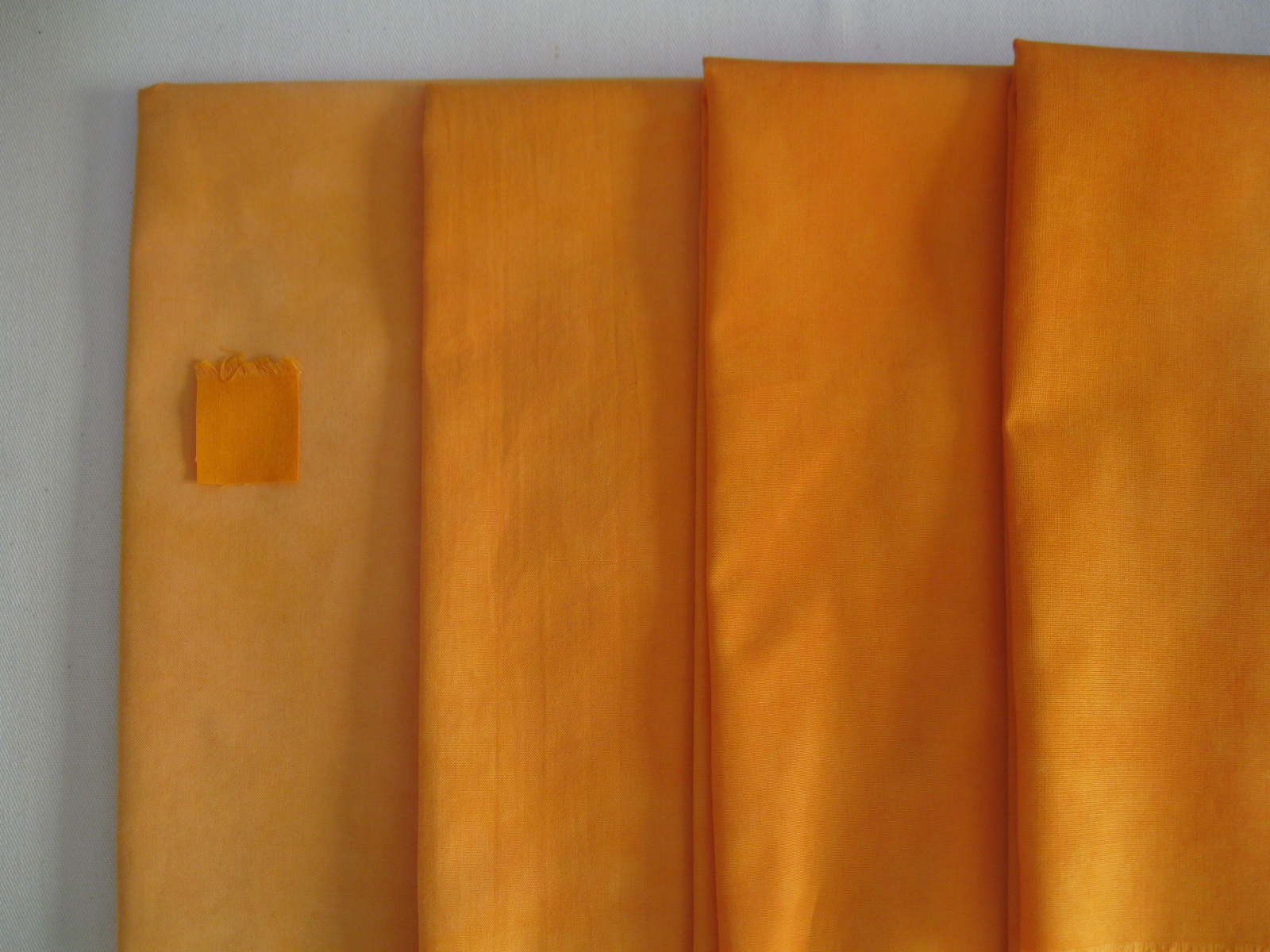
(double-click on the photo for a close-up and a much better version of the color) This post may be too technical for anyone not interested in dyeing fabric. Feel free to skip! Last year I tried out various "pfd" fabrics (prepared-for-dyeing, with no surface treatment that would interfere with the dye), and settled on Kaufman Patina for my standard fabric to dye. I purchase it online from Fiber on a Whim, and I went through 20 yards of it this summer. I chose this fabric because it has a beautiful hand, as well as taking up the dye very well, and it is well-suited for hand-applique as well as piecing. I understand that it is the base fabric used for Kaufman batiks. This is all good, but with cotton prices going up, I'd like to have a supply of a less expensive material as well, that I could use strictly for piecing and that I would feel more free to experiment with than a fabric that costs over $7/yd. If it was something I could get locally at JoAnn Fabrics, which regularly puts out 40% off coupons, that would bring the price down significantly. And if I could find a 90" fabric that would dye well, that would be convenient for the backings of quilts. So, I did a trial on four fabrics. Besides Kaufman Patina, I dyed regular white Kona cotton (not pfd), Kona Premier muslin (bleached), and Legacy Supreme muslin (bleached); the last two were 90" wide. I had high hopes for the two muslins, both of which are a higher thread count than ordinary muslin. The results are in the photo at the top. I put them from lightest on the left to darkest on the right, though the two fabrics on the right are quite close. To my surprise, the winner was the Kona cotton. The little square of orange on top of purple on the right is the sample square from Carol Soderlund's class; it's indistinguishable from the color I got on the Kona, and it disappears on the next one also, which is Kaufman Patina. The 3rd best was Kona premier muslin--not quite up to the value of the sample, but good enough that I would consider using this fabric, adjusting the amount of dye used. The fabric itself is not anything as nice as the Patina, but it is lighter and a higher thread count than the regular Kona. Legacy Studio came in last--so pale that it's not worth using this again. So, I am certainly not abandoning the Patina, but I feel I have a couple of other options as well. I may look for some other white fabric to try as well. Oh, I did "scour" the non-pfd fabrics before dyeing; for scouring, I washed in hot water with soda ash and Synthrapol). Here's a photo that shows the class sample on top of the Kona cotton (best in the trial, furthest to right):
And here's one that shows it on top of the Legacy Studio (worst in the trial, furthest to left):
Added 10-4-11: Here is an additional trial that I finished today. On the left is the Kaufman Patina. In the middle is Roclon Bamboo-Cotton, scoured before dyeing, and on the right is the same Bamboo-Cotton, but not scoured first. The little square sample from Carol Soderlund's class is on the middle piece--it blends in so well that it's very difficult to see. If you double-click to enlarge the photo, you'll see little tufts of selvage at the top edge of it. Someone on the MX-Dyers list mentioned that they didn't scour this fabric before dyeing, even though it's not marketed as PFD (prepared for dyeing). You can see that the results are close to identical with the scoured sample in the middle. (More mottling on the two bamboo/cotton pieces because I didn't feel like taking the time to manipulate the fabric as much as I did on the earlier samples.) The bamboo/cotton has a lovely feel to it. It is a little heavier than the Kaufman Patina, so probably wouldn't work as well for applique, though I haven't tried it. I was eager to try this fabric, because it is more than $2/yd less than the Kaufman. But alas, it seems that JoAnn Fabrics is no longer carrying this by the bolt, and that Roclon may have stopped producing it. Well, at least I have the Kona option available.
And here's one that shows it on top of the Legacy Studio (worst in the trial, furthest to left):
Added 10-4-11: Here is an additional trial that I finished today. On the left is the Kaufman Patina. In the middle is Roclon Bamboo-Cotton, scoured before dyeing, and on the right is the same Bamboo-Cotton, but not scoured first. The little square sample from Carol Soderlund's class is on the middle piece--it blends in so well that it's very difficult to see. If you double-click to enlarge the photo, you'll see little tufts of selvage at the top edge of it. Someone on the MX-Dyers list mentioned that they didn't scour this fabric before dyeing, even though it's not marketed as PFD (prepared for dyeing). You can see that the results are close to identical with the scoured sample in the middle. (More mottling on the two bamboo/cotton pieces because I didn't feel like taking the time to manipulate the fabric as much as I did on the earlier samples.) The bamboo/cotton has a lovely feel to it. It is a little heavier than the Kaufman Patina, so probably wouldn't work as well for applique, though I haven't tried it. I was eager to try this fabric, because it is more than $2/yd less than the Kaufman. But alas, it seems that JoAnn Fabrics is no longer carrying this by the bolt, and that Roclon may have stopped producing it. Well, at least I have the Kona option available.
August 20, 2011
Table runner-rectangular appliqué
I like to have handwork with me when I travel. I put together these simple blocks, playing with solids and scraps of batik. I intended to make a baby quilt, but I'm having too much pain in my hand from doing applique, so I called it quits and made a table runner (12 x 32"), which I'm quite happy with. I cut the batik rectangles by hand, and I like the way some sides are a little curvy, and angles are not necessarily 90 degrees. It's also a satisfying way to use up bits of fabric on hand. I'm going to try out some methods of machine applique, and perhaps do more of these blocks, but eliminating the hand sewing.
I tried out various fabrics for binding, and like this one that has both lavendar and gray in it; not a fabric that appears in the blocks, but it ties things together nicely. (Click on any of the photos for a larger view.)
When putting together the blocks, I just paid attention to the color of the solid background and the colors and shapes of the two rectangles on that particular block. Then, when putting together the table runner, I moved the blocks around until I found something pleasing. If I do this again, I think I would try laying out the solid blocks, and then laying out the rectangles on top. More work up front, but a more direct way to the composition.
Again, I did just the straight-line quilting, about 5/8" apart. Done!
August 11, 2011
Pine Grove/Stones
The making of this quilt goes back more than two years. Here's the story of the front.
And some details:
Both top and back have been finished for close to two years, but then I couldn't decide how to quilt it. I considered many different approaches. After finishing the simple straight line quilting a few weeks ago on the half-square triangle "Magenta and Friends," I realized something that simple would also be a good solution for this quilt. It took me a while, but I think this was a good decision!
Here's the back of the quilt. I had to line up the quilting by the seams on the front of the quilt, and I was worried about how they then wouldn't line up precisely on the back. They don't, but it still looks fine.
More of the story about the back continues here.
Some details: First, one of the blocks from the very beginning:
And here's an example of the larger stones sliced up--this may be my favorite spot in the quilt:
Here's another small quilt that involved cutting up stones.
This quilt is going to my brother, a potter. He has made beautiful ceramic stones.
And here are a few of his wood-fired pots:
I will miss this quilt, but I know it is going to a good home!
August 2, 2011
Half-square Triangle with Magenta & Friends--done!
I'm very happy with this finished quilt (38x44). My hand-dyed fabric, quilted with a teal Invisafil thread, a very thin polyester thread that sinks nicely into the fabric. I quilted this simply with parallel lines, following the example from SewKatieDid. I ended up putting the lines vertical instead of horizontal, because I made a back that was large horizontal stripes, and I didn't want to worry about horizontal quilting lines not matching up on the back.
For the back, I used fabric that came out poorly, with water spots, because of my not taking care with the flat-dyeing method. But hey, they look OK on the back.
The binding: I basted four different colors on the quilt, trying to decide which one to use. My husband David suggested I use all four. Good idea!
I was thinking I would give this quilt away as a baby quilt, but I think I'll keep it as a wall hanging for myself. I find the colors very appealing, as well as the combination of structure and randomness.
June 29, 2011
Finishing up slanty rail fence
I recently finished up a small quilt (36x36) that I started a while back, something fun to piece to take a break from a large piece I was quilting. This small quilt was done from scraps of solid fabric that I had on hand. I am pleased with the color work here. Though it may look like a huge range of virtually all colors, it actually took some significant selection, which I was able to do without agonizing. I couldn't have done that a couple of years ago--nice to feel the progress in working with color.
Quilting is still a big challenge. I did many samples on extra, individual blocks before deciding on a simple wavy line through each "slice." I'm fairly pleased with this, both in terms of ease of sewing and in the final look.
Here's the back of the quilt. I first made a simple line-up of fat slices that went across the whole back, but that arrangement looked boring. So I cut it into four pieces, moved the pieces around, and came up with this. I like it.
The quilting on the back looks like fat noodles:
June 28, 2011
Working with large-scale prints
This is a quilt I finished recently. I was interested in using some large-scale prints, not something I'd not done much of before. I used a very simple pattern of rectangles to show off the prints--"Carousel," by Kim Shaefer, Cozy Modern Quilts (C& T, 2009). I'm pleased with how this turned out.
This detail shows the two different fabrics I used for the binding; I had assumed I would use green, but the light teal looked much better. The very nice quilting was done by Mary Walck, a long-arm quilter in Galesburg.
And here's the back--most of it a large piece of sage-colored Kona cotton that I over-dyed with greens and brown, and then an extra piece of hand-dyed yellow-green to complete the back.
Subscribe to:
Posts (Atom)